
High-Performance Carbide End Mills by CGS Tool
Precision Tools for Advanced Machining
When it comes to CNC machining, tool choice is everything. CGS Tool’s high-performance carbide end mills are engineered to maximize feed rates, extend tool life, and deliver precision finishes in the most demanding environments.
Key Advantages
Available in 2, 3, 4, 5, and 6 flute designs
Optimized for aluminum, stainless steel, titanium, Inconel, and alloys
Variable helix & index geometries reduce chatter and vibration
Advanced coatings (ZrN, ALTiN, AlCrN, nACRo) for heat and wear resistance
Styles include square end, ball nose, and corner radius options
Engineered for Every Job
Ferocious & Ferocious 3X – Chip evacuation and high-speed aluminum machining
HV (Hi-Velocity) – Alloy & steel machining at higher RPMs
VMAX (MX) – Titanium and high-temp alloys with maximum stability
EF-5 Tornado – Strength and surface quality in finishing applications
Storm – Exotic alloys with eccentric relief for edge strength
Beast – Roughing and finishing in one aggressive cutter
No matter the material or complexity, CGS Tool has a high-performance solution to fit your operation.
Choosing high performance end mills for Tough CNC Jobs
A cutter starts clean, then the finish turns rough. Heat builds up. Chips stop clearing the way they should. Maybe chatter appears halfway through a production run that was supposed to be routine. These are the moments when standard tooling begins to show its limits, and high performance end mills become a serious consideration for shops that need better control, longer wear resistance, and more consistent part results.
Why Standard End Mills Can Fall Short
Standard end mills can handle basic cutting work, but harder materials and faster feed conditions demand more from the tool. Once the job involves tighter tolerances, longer cycle times, or difficult alloys, tool geometry starts to matter much more.
Common problems include:
- Excess heat near the cutting edge.
- Poor chip flow during deeper cuts.
- Chatter marks on finished surfaces.
- Faster edge breakdown in harder metals.
- Unstable results when feed rates increase.
For CNC teams, the issue is rarely just the tool itself. It is the match between tool design, workpiece material, machine setup, and cutting strategy.
What Makes Carbide Tooling Different?
High-performance carbide end mills are constructed to be rigid, strong at the edge, and to wear well. Carbide holds up better than many standard tool materials when the job involves heat, speed, or abrasive metals.
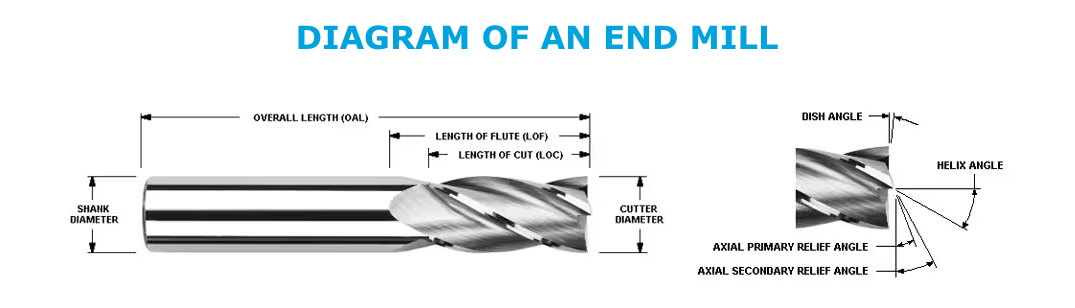
The difference is not only in the carbide blank. Flute design, coating choice, relief angles, and end geometry all affect how the tool behaves under load. A well-matched end mill can help improve chip control, reduce rubbing, and support a cleaner finish across repeated runs.
That matters when production cannot afford constant tool changes or inconsistent part accuracy.
How Material Choice Affects End Mill Selection
The right end mill depends heavily on what is being cut. Aluminium, stainless steel, titanium, and high-temperature alloys all behave differently under the tool.
For example:
- Aluminum often needs strong chip evacuation and polished flute paths.
- stainless steel end mills need edge strength and heat control because stainless steel can work-harden during cutting.
- titanium end mills need a stable geometry because titanium holds heat near the cutting zone.
- Inconel and other tough alloys require coatings and tool designs that resist abrasion and thermal stress.
Choosing by diameter alone is not enough. Shops also need to consider flute count, helix angle, coating, reach, corner style, and finish requirements before ordering.
How Variable Helix Designs Reduce Chatter
Chatter is one of the most frustrating problems in milling. It affects finish consistency, tool wear, and sometimes part accuracy. variable helix end mills help by changing the spacing and rhythm of the cutting forces.
Instead of each flute hitting the material in the same repeated pattern, variable helix geometry disrupts vibration. That can help the tool cut more smoothly, especially during side milling, slotting, or higher-speed CNC work.
The result is better control at the spindle, less noise in the cut, and a more reliable surface finish.
Coatings and Geometry Features to Review
Coatings and geometry should match the job, not just the tool size. What is a good coating to use on aluminium may not be suitable on titanium or stainless steel.
The major considerations to discuss are:
ZrN: usually helpful with non-ferrous metals and aluminium.
AlTiN: aids in the heat resistance of harder materials.
AlCrN: assists in high-temperature cutting wear resistance.
nACRo: can be used when heat and abrasion are significant issues.
Corner radius: provides an extra edge strength to harder cuts.
Ball nose: is effective in contouring and 3D profile.
Square end: carries pockets, walls, and sharp floor transitions.
The number of flutes is important too. The additional flutes are able to assist in the quality of finish, whereas the reduction in flutes tends to assist in chip space.
Matching CGS Tool Series to the Job
CGS Tool offers several end mill series designed around different cutting needs. That helps shops narrow the choice based on workpiece material, chip control, and production goal.
Ferocious / Ferocious 3X: useful for aluminium work and aggressive chip evacuation.
Hi-Velocity: suited for alloy and steel cutting at higher RPMs.
VMAX MX: built for titanium and high-temperature alloy work.
EF-5 Tornado: helpful when finishing, consistency and edge strength matter.
Storm: made for exotic alloys and difficult cutting conditions.
Beast: supports aggressive roughing and finishing in one toolpath strategy.
This type of series-based selection makes high-performance end mills easier to choose because buyers can connect tool design with real shop-floor needs.
Final Buying Guidance
Before choosing an end mill, review the material, toolpath, machine rigidity, flute count, coating, and finish target. The right choice should support chip flow, reduce heat, and keep the cut controlled from the first part to the last.
CGS Tool gives machining teams access to end mill series, speeds and feeds resources, and catalogue details that can help match the tool to the job. For shops comparing high-performance end mills, that guidance can make selection more practical and less guess-based.
FAQs
What are high-performance carbide end mills?
High-performance carbide end mills are cutting tools that offer improved wear resistance, feeding, or feedability, finish and control in challenging CNC cutting.
Which materials can these end mills machine?
They can machine materials such as aluminum, stainless steel, titanium, Inconel, alloys, and other metals, depending on the selected series, coating, and geometry.
How do variable helix designs reduce chatter?
Variable helix designs change the cutting rhythm of the flutes, helping interrupt vibration patterns and support smoother cutting.
What coatings are available for these tools?
Popular coating choices consist of ZrN, AlTiN, AlCrN and nACRo where each coating is tailored to various heat, wear and material environments.
Which end mill series is best for specific applications?
Ferocious works well for aluminum chip evacuation, VMAX MX fits titanium and high-temperature alloys, Storm supports exotic alloys, and Beast is useful for aggressive roughing and finishing.
What are high-performance carbide end mills?
Carbide cutting tools. Run faster, last longer, and and cut cleaner than standard end mills.
What are the best high performance end mills for aluminum machining?
Ferocious or Ferocious 3X series. Polished flutes, good chip evacuation — aluminium clears fast.
Which end mills for stainless steel machining are most effective?
Heat-resistant coating, reinforced edge, stable geometry. Those three matter most in stainless.
Are high performance end mills suitable for machining titanium alloys?
They can handle titanium. The tool needs proper coating and solid geometry — without that, the edge breaks down fast.
How do variable helix end mills improve performance in difficult materials?
Changes the cutting rhythm. Chatter drops, tool stays stable in tough materials.