
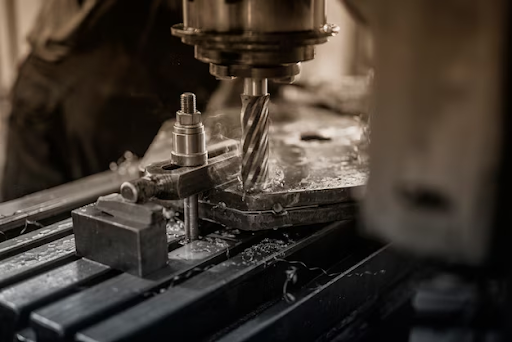
Carbide end mills have transformed the manufacturing industries that use precision machining. Carbide tools made of just carbide, because of their excellent hardness, wear resistance and cutting efficiency, are far superior to traditional steel tooling. In this article, we discuss in further detail how carbide end mills improve the performance of CNC machines.
Differences between carbide and other tool materials
Compared to HSS and Cobalt materials, carbide cut tools have superior hardness (82 HRC) and heat resistance, providing the ability to machine at speeds 3 -10 times faster than either HSS or Cobalt, offering a finish surface at high volumes and offering longer tool life.
Key Differences between Tool Materials.
Carbide versus PCD
`PCD tool has premium wear resistance versus carbide milling tools and will last significantly longer in producing high-volume abrasive materials.` Carbide has many purposes for many types of production material, but PCD tooling is used in the finishing process of nonferrous materials to produce a high-quality finish. PCD tooling can be used 10 times faster than carbide tooling.
- While carbide is a brittle material that can break/chip under vibration, vibration means a setup will not be stable, due to how tough HSS is compared to carbide in those setups that use manual setups, where HSS are a lot tougher than carbide.
- As carbide will hold its sharpness and retain maximum hardness (67 HRC for carbide through cobalt - 60 HRC) through temperature, HSS is able to achieve a higher speed cutting rate.
- The life and performance of carbide tools will last much longer, thus being able to provide a high-quality finish through having sharper cutting edges and having much less downtime for changing tools.
- While carbide is more expensive in price than HSS at the time of purchase, it will typically have much lower costs per part produced due to longer tool life; therefore, it will provide better ROI over time in high-volume production.
Carbide vs. cermet
- Cermet is more wear-resistant than true carbide (though it doesn't smear as easily).
- In terms of toughness, cemented carbide will have a greater compressive strength and be more resistant to thermal shock than cermet.
Performance advantages in CNC machining
CNC end mills machines provide premium performance via extraordinary precision, unparalleled repeatability and high -speed automated production, offering complex parts with tolerances often within +0.0001 inches. It elevates efficiency by running 24/ 7 with less supervision, lowering labour costs and enabling rapid, flexible and frequent production for both prototypes and massive manufacturing.
Key Performance Advantages
Here are the key upsides of performance in CNC machining :
- Superior repeatability: once the CNC has been programmed, it can produce multiple essentially identical parts, so the quality stays steady across the whole run (batch).
- High-performance end mills, strong accuracy: the computer-guided cutting tool removes material with extreme control, which makes it ideal for intricate, tight-tolerance parts in areas like medical and aerospace.
- Operational efficiency, kind of in one go: modern CNC machining centres can combine several functions, like milling, drilling, and turning, all within the same setup. This reduces the need for manual part swapping, and it speeds up output.
- Better productivity and faster turnaround: because the process is automated, and the machines can run almost continuously 24/7, overall cycle time drops a lot, and human mistakes are far less likely.
Impact on cutting speed and efficiency
Optimising cutting speed is sort of a juggling situation, between pushing production efficiency higher up and still keeping the tool in one piece for longer, you know. When the speed ramps up, you tend to see a higher Material Removal Rate (MRR), and the overall output climbs as well, but if the speed gets too aggressive, it makes extra heat, and honestly, that can drag tool life down fast.
- Material Removal Rate (MRR): Turning the speed up is a strong lever to raise MRR, which then lifts productivity
- Production tempo: Higher cutting speeds typically mean the spindle is rotating faster, higher RPM, and the tool travel feels quicker, which usually shortens cycle times
- Surface finish: Higher speeds may help surface finish in more compliant or softer materials, yet if the settings are off, either too low or too high, vibrations can show up, and then surface quality suffers
- Tool life management: Pushing speed usually means more heat and more frictional wear, in particular on tougher materials, so tool failure comes sooner
For example, a 50% rise in cutting speed can cut tool life by as much as 80% - Material hardening: At very high speeds, some workpieces, such as heat-treated steels, can harden even further, so machinability drops, and the added stress can also end up harming the tooling
Tool life and consistency improvements
Tool life basically means how long or how many cycles you can use a given tool before it needs replacement. Since it affects machining accuracy and the overall product quality directly, it is important to know what’s going on, even a bit better than “just use it until it breaks”.
Improving tool life frequency means you have to fine-tune the cutting parameters, which includes reducing the speed, plus setting the feed the right way, using current coatings ( TiN, TiAIN, DLC) and making sure the setup is rigid and stable, so vibration stays low, as much as possible.
The various strategies for tool life and consistency include boosting cooling and lubrication, tuning the cutting parameters, applying more advanced coatings, increasing rigidity and stability, keeping up with tool maintenance and reconditioning, reusing and recycling where suitable, and running predictable processes that don’t surprise you later.
Ideal applications for carbide end mills
Carbide end mills are pretty much spot on for high-speed machining, rigid setups and trimming hardened materials, because of their top-tier hardness, good tolerance to heat, and long working life. Practically, they’re also great for precision engineering, giving a fine surface feel in things like stainless steel, titanium, cast iron, alloys and composites across aerospace and automotive work, you know.
If you’re looking at the ideal jobs for carbide end mills, it includes hard material machining, slotting, contouring, high-speed machining, finish milling, and high-temperature cutting.
Conclusion
High-speed CNC machining requires cutting tools that can withstand mechanical and thermal loads without sacrificing reliability or precision. CGS Tool solid carbide end mills offer unmatched performance across a wide range of materials when properly matched to the application.
By opting for the correct solid carbide end mills series for specific materials such as titanium alloys, aluminium, stainless steel, mould steel, and hardened steel, manufacturers can significantly enhance productivity, improve tool life, and achieve more stable and consistent machining performance.