
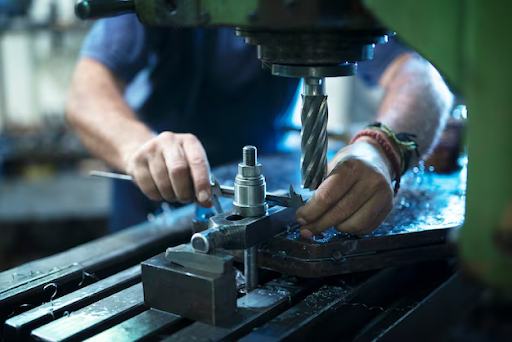
Custom tooling in CNC machining is a major piece of the puzzle for getting very high-precision parts made with better efficiency. It gets tuned for specific jobs, and these bespoke tools can give real advantages compared to standard tooling, mostly when you’re working in aerospace, medical/healthcare, or electronics, where part complexity and performance can’t be compromised. In this post, we’ll look at how custom tools really affect production flow and machining accuracy.
Role of custom tools in CNC machining
Custom tools for CNC machining tools are built to fit, especially non-standard tooling. Usually, these tailored tools are made to shape one-of-a-kind, intricate, or very high-precision features that standard tools can’t really do as efficiently. They play a key part in boosting production pace, combining multiple operations into a single pass, and keeping accuracy really tight. You can see this mostly in medical and aerospace industries, where “good enough” simply doesn’t work.
Key Advantage and Roles
- Reduced cycle Times: By merging several operations like drilling, boring and chamfering into one tool setup, they really reduce tool changes and overall machining time, pretty noticeably.
- Elevated Precision and Quality: They help you reach extremely tight tolerances that regular off-the-shelf tools just can’t manage at all.
- Complex Geometry Production: Custom tools such as custom end mills, and form tools are designed for specific profiles, deep cavities and those tight complex inner corners, where standard solutions are too limited.
- Increased tool Life: With optimised geometry, the wear drops, which can lower the total cost per part in the end.
- Optimised performances on hard materials: Custom tools are built using specialised materials and geometries that are tuned for difficult-to-machine workpieces.
Limitations of standard tools
Common tools are usually held back by less power, slower speed, and a higher level of labour intensity than power tools. So you end up with more operator fatigue and less overall efficiency. They also tend to give only modest precision; they basically lean on human strength for the needed force, and they ask for some operator know-how so the results stay steady.
Key Limitations of Standard /Hand Tools
- Limited Precision & Consistency: It’s pretty hard to get high precision results that stay uniform, especially when you have to do continuous work and such.
- Physical limitations: it pretty much depends on human labour and strength, which makes production slower and causes more worker fatigue, too
- Safety Hazards: if someone uses a tool in the wrong way, like for a purpose it wasn’t designed for, or if maintenance is ignored, you can end up with injuries, broken tools or slips and all that.
- Lower Power: They actually reduce the high torque and overall force that electric, pneumatic, or hydraulic tools can provide.
- Maintenance Needs: even though they’re simpler than powered tools, they still require regular upkeep, like sharpening or else performance drops.
- Lack of Intelligence: compared with newer powered tools, normal manual tools don’t have advanced protections, say like safety clutches, for example, that can help prevent damage when things bind up.
Accuracy improvements with custom tools
Industrial cutting tools accuracy is the cornerstone of precision manufacturing to obtain similar measurements and fine-tolerance cutting. High-accuracy toolings, such as CNC-controlled systems, allow repeatable precision, an important part in aerospace or medical devices. For example, obtaining a 0.001 -inch tolerance ensures components such as turbine blades or surgical instruments fit and function perfectly. Machine calibration and a sharp cutting edge are crucial to prevent deviations and maintain batch-to-batch consistency.
Production efficiency and output gains
custom tooling solutions drastically accelerates production and ensures micron -level machining accuracy. By customising cutting geometries and fixtures to certain operations, manufacturers minimise expensive changeovers, eliminate part scrap and significantly encourage overall production efficiency.
Production Efficiency & Output Gains
- Optimized Feed Rates: Tailored cutters with optimised geometries can support higher cutting speeds and enhance Material Removal Rates ( MRR).
- Minimized Setup Times: Custom fixtures and instant change tooling systems enable quick transitions between production runs, minimising equipment calibration downtime.
- Fewer Interruptions: Tools engineered for certain materials secure fast tool wear and breakage, leading to longer lifespans and less production line downtime.
Considerations before choosing custom tools
Custom tools are engineered to bypass the limitations of generic, off-the-shelf tooling. Prior to adopting custom tool manufacturing must carefully analyse their machining processes to ensure the higher initial investment translates into tangible advantages like longer tool life, faster cycle times and precision.
Key Considerations Before Selecting Custom Tools
- Production Volume: High volume runs will recover the start tooling costs much quicker. Custom tools are great for long term repeatability and reducing wear over thousands of cycles.
- Workpiece Material & Geometry: Hard or difficult-to-cut metals (e.g. titanium, inconel or highly intricate part geometries) often require custom substrate compositions and edge preparations.
- Machine Capacity & Limits Make sure your CNC machine or manufacturing system has the spindle power, rigidity and tool storage capacity to properly use the custom tool.
- Budget & Long Term ROI: Custom tools have the highest upfront costs, but many times will lower the total cost per part by producing the part faster and less material waste.
Conclusion
Precision cutting tools that offer unmatched accuracy, efficiency, and versatility across industries are essential for today's manufacturing. To achieve the best results and minimise waste and downtime, manufacturers should use the right tools while carefully monitoring tool wear, material compatibility, and production requirements.
As technology advances and the need for sustainability grows, precision cutting solutions from CGS Tool continue to evolve to deliver improved performance and longer tool life. Whether you're working on complex designs or high-volume production, precision cutting tools remain vital to achieving your quality and efficiency goals.