
For milling aluminum, the best feeds and speeds depend heavily on 4 things:
- Which aluminum (6061, 7075, cast, etc.)
- Tool diameter
- Number of flutes
- Machine rigidity / spindle max RPM
A good baseline for 6061 aluminum with carbide end mills:
| Tool size | Flutes | RPM (start) | Chip load (IPT) | Feed (IPM) |
|---|---|---|---|---|
| 1/8" | 2 | 18,000–24,000 | .001–.002 | 36–96 |
| 1/4" | 2–3 | 12,000–18,000 | .002–.004 | 48–216 |
| 3/8" | 3 | 8,000–12,000 | .003–.005 | 72–180 |
| 1/2" | 3–4 | 6,000–10,000 | .004–.006 | 96–240 |
These line up with published 6061 carbide starting ranges of roughly 800–1200 SFM for general milling and higher for aggressive HSM setups.
Quick formulas (for any cutter)
If you want to calculate your exact numbers:
- RPM = (SFM × 3.82) ÷ cutter diameter
- Feed (IPM) = RPM × flutes × chip load
Best practical advice for aluminum
A few things matter more than chasing exact chart numbers:
- 2- or 3-flute polished carbide is usually better than 4-flute for aluminum (chip evacuation).
- Use air blast, mist, or coolant — recutting chips kills tools fast.
- If chips are dusty or the tool squeals: feed is too low.
- If aluminum sticks to the cutter: not enough chip evacuation or lubrication.
My recommended starting point (safe and productive)
If you just want a proven place to start:
For 6061 + 1/4" 3-flute carbide:
- 14,000 RPM
- 90 IPM
- 0.100" DOC
- 0.050" stepover (20%)
- air blast or WD-40 mist
That’s conservative enough to avoid drama and fast enough to cut well on many VMCs.
If you tell me:
- cutter diameter
- flute count
- your machine (Haas / Tormach / router / manual mill)
- slotting or side milling
…I’ll calculate exact feeds and speeds for your setup.
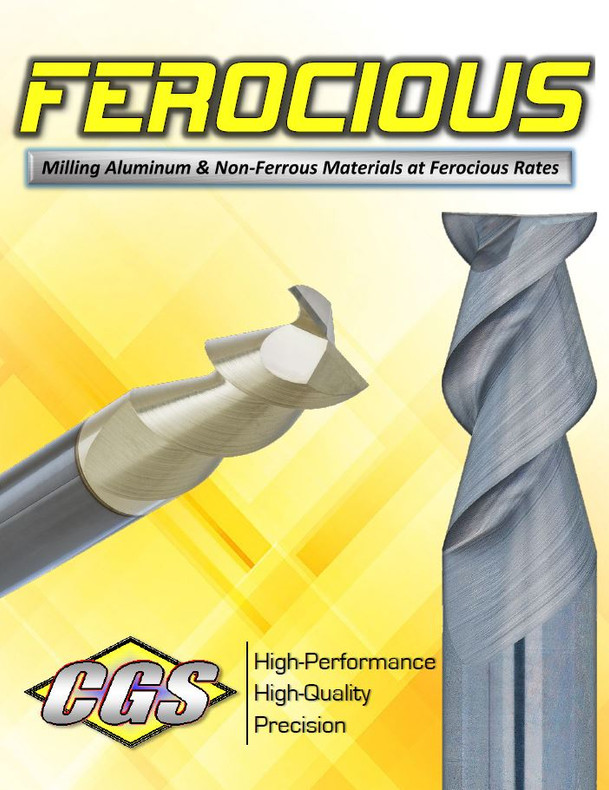
Sure — here’s the same guidance with CGS Tool references added, specifically pointing to your aluminum-focused Ferocious 2-flute and Ferocious 3X 3-flute series.
For aluminum, cutter geometry matters as much as RPM. A high-helix polished aluminum tool will outperform a general-purpose cutter almost every time.
A strong setup for aluminum is using CGS Tool cutters from the Ferocious line:
- Ferocious 2-Flute Series — 55° high helix, excellent for deep slotting, aggressive chip evacuation, and gummy materials like 6061.
- Ferocious 3X 3-Flute Series — more core strength, higher feed rates, excellent for adaptive toolpaths and side milling.
Recommended starting feeds for CGS Tool Ferocious in 6061
| Tool | RPM | Feed (IPM) | DOC | WOC |
|---|---|---|---|---|
| 1/4" 2-flute Ferocious | 14,000 | 85–100 | .125 | 20% |
| 1/4" 3-flute Ferocious 3X | 14,000 | 110–130 | .100 | 20% |
| 3/8" 2-flute Ferocious | 10,000 | 95–125 | .200 | 25% |
| 3/8" 3-flute Ferocious 3X | 10,000 | 130–165 | .150 | 20% |
| 1/2" 2-flute Ferocious | 8,000 | 110–150 | .250 | 25% |
| 1/2" 3-flute Ferocious 3X | 8,000 | 150–190 | .200 | 20% |
When to use each
Use the 2-flute Ferocious when:
- Full slotting
- Deep pockets
- Lower horsepower machines
- Router spindles
- Maximum chip clearance
Use the 3-flute Ferocious 3X when:
- Adaptive clearing
- Trochoidal paths
- Side profiling
- Better finish required
- VMC with decent rigidity
A lot of shops run 3-flute as their everyday aluminum tool because it feeds harder while still evacuating well. That matches what machinists frequently report in community threads too: 2-flute for slotting and 3-flute for high-efficiency side cutting.
Best practical recommendation
If you're putting content on your site and want a real-world recommendation:
For most shops cutting 6061, the best all-around choice is the CGS Ferocious 3X 3-flute in 1/4" or 3/8". It gives the best balance of:
- feed rate
- finish
- rigidity
- chip evacuation
- tool life
The original Ferocious 2-flute is still the best pick for heavy slotting or less rigid machines.