
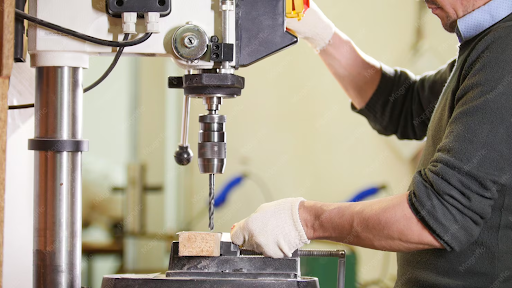
If you are fresher to machining, you might be wondering what an end mill is. It is basically a type of cutting tool that is utilised in milling applications. It is a rotating tool that is used to eliminate material from a workpiece. End mills are usually made of high -speed (HSS) or carbide and come in a variety of shapes and sizes . They are available in solid and indexable milling styles.
The end mills are commonly used in milling machines that use rotary cutters to remove material from a workpiece. The milling cutters move the workpiece against the rotating end mill which cuts into the material and removes chips of material to create a desired shape.
In this post, we will walk through the simple ways to understand end mills in CNC machining.
Basics of end mills and their function
An end mill is a versatile rotating cutting tool utilised in milling machines and CNC milling tools routers to eliminate materials from a workplace. Unlike standard drill bits that only remove straight down along a single axis, end mills feature cutting edges on both their sides and bottoms, enabling multi direction cuts.
How they function :
End mills function fundamentally such as microscopic spinning knives. They rotate at large speeds and bottom, enabling for multi directional cuts.
The main functions of an end mill involves :
- Slotting & Pocketing : Plunging into the material and carving out internal cavities or channels.
- Profiling & Contouring : Moving along the edges of the material to cut out certain shapes.
Types of end mills and their uses
Choosing the correct shape relies completely on the cut and finish you want to obtain.
- Ball End Mills: Feature a rounded, hemispherical tip. They are mainly used for complex 3D carving, contouring and sculpting curved surfaces.
- Roughing End Mills: It is also known as ‘hog mills. These features have serrated, wavy edges designed to chew via large volumes of materials very instantly though they leave a rough surface finish.
- Square End Mills: The standard workhouse. They have a 90 degree flat tip, which makes them ideal for standard pocketing, making slots and creating sharp corners.
- Charmer End Mills: Designed specifically to cut angled bevels or deburr the edges of parts.
- Corner Radius End Mills: Have slightly rounded edges on a generally flat bottom. This strengthens the edge of the tool, preventing it from chipping and creates a minimal curved fillet in the internal corner.
Applications in CNC machining work
CNC machining is the backbone of modern manufacturing. Basically manufacturers can use computer - controlled tools to make parts with complex geometries , tight tolerances and great finishes . In general, this type of machining supports several applications from aerospace to robotics making it a must-have in engineering and production.
Aerospace Industry
The aerospace industry relies on CNC end mills machining to produce parts that are lightweight, precise, and capable of withstanding extreme operating conditions. Aerospace components often use exotic materials such as aluminium and titanium, which can be challenging to work with but are effectively controlled through CNC machines. This helps manufacturers balance weight savings with structural strength. CNC machining also manufactures high-precision components such as turbine blades, landing gear parts, and structural brackets, where strict tolerances are essential for aircraft safety and performance.
Robotics and Automation
The robotics industry uses CNC machining to produce parts with exceptional precision and consistency. Robotic arm components such as high-accuracy gears, joints, and frames are essential for robotics systems, where reliable and precise movement is non-negotiable. CNC machining also supports automation systems by producing tailored parts for automated conveyors, pick-and-place machines, and assembly line equipment, helping maintain tight tolerances and long-lasting performance.
Renewable Energy and Green Technologies
CNC machining is crucial to advancing renewable energy systems and sustainable solutions. In wind turbines, precision-machined parts such as bearings, shafts, and housings are important for ensuring efficient and reliable performance under frequent stress. CNC machining also supports solar power systems by creating tailored mounts, frames, and thermal components for solar panels and other green technologies, helping ensure durability, accuracy, and precise installation.
Medical and Dental Applications
CNC machining is a vital component in the development of renewable energy systems and sustainable solutions. For wind turbines, precision machine components such as housings, bearings, and shafts are important to help them operate reliably and efficiently under frequent stress. CNC machining also supports solar power systems by producing custom mounts, frames, and thermal components for solar panels and other green technologies, ensuring long-lasting performance and precise installation.
Electronics and Electrical Components
CNC machining is indispensable for producing electronics and electrical components where precision is significant. Heat sinks made from materials such as aluminium are often machined to exact specifications to ensure optimal thermal performance in electronic devices. CNC machines also create small, intricate precision parts such as connectors and circuit board housings, which need high accuracy to function effectively in compact devices.
Selecting the right end mill
Opting the right end mill requires balancing your workpiece material, the required shape and your machine’s rigidity.
- Flutes : Opt 2-3 flutes for aluminium and plastics for better chip evacuation; use 4+ flutes for steel and harder alloys for a finer finish.
- Materials : Use high - speed steel ( HSS) for wood and plastics and solid carbide end mills for harder metals like steel.
- Shape : Use square end mills for flat bottoms/walls ball -nose for 3D contouring and corner radius to decrease chipping.
Common mistakes in end mill usage
Common end mill mistakes such as incorrect feeds, poor tool holding and ignoring runout, lead to premature tool wear and broken bits. Mastering end mill usage needs careful attention to cutting mechanics, tool geometry and machine setup.
Here are the common mistakes in end mills -
- Incorrect feeds and speeds
- Chip re-cutting ( Insufficient chip clearances)
- Using the wrong no of flutes
- Excessive Tool Overhang (stick -out)
- Incorrect Cutting Strategy
Conclusion
For superior quality CNC production results, it's crucial to learn about what each kind of end mill does (and how they work). Whether creating seamlessly curved 3D shapes with ball nose end mills, making deep hollows with tapered end mills, or milling precision slots with T-slot cutters, the choice of tool will have a significant impact on the overall success of your project.
By opting for the correct type of end mill, manufacturers can lower tool replacement frequency, elevate productivity, and produce more consistent, precisely manufactured parts. This information is especially beneficial for robotic CNC operators and their teams who are striving to achieve optimum efficiency in their machining processes with CGS Tool solutions.