Concentric vs Eccentric Relief in End Mills: Which One Delivers Better Tool Life & Performance?
In the world of high-performance carbide end mills, flute count, helix angle, and coating get most of the attention. But one critical geometry feature often overlooked is the OD relief behind the cutting edge. The choice between concentric relief (conventional) and eccentric relief can dramatically impact cutting edge strength, wear resistance, tool life, and surface finish — especially when machining tough materials like titanium, Inconel, hardened steels, and stainless.
Here’s everything machinists, programmers, and manufacturing engineers need to know about concentric vs eccentric relief end mills.
What Is End Mill Relief Geometry?
Every carbide end mill has a cutting edge followed by a relief zone. This relief prevents the tool body from rubbing against the workpiece, reducing friction and heat. The shape of that relief zone determines how much carbide supports the cutting edge and how the tool performs under real cutting forces.
There are two primary relief designs:
- Concentric Relief (also called conventional or hollow-ground relief)
- Eccentric Relief (also called convex or offset relief)
Concentric Relief: The Traditional Method
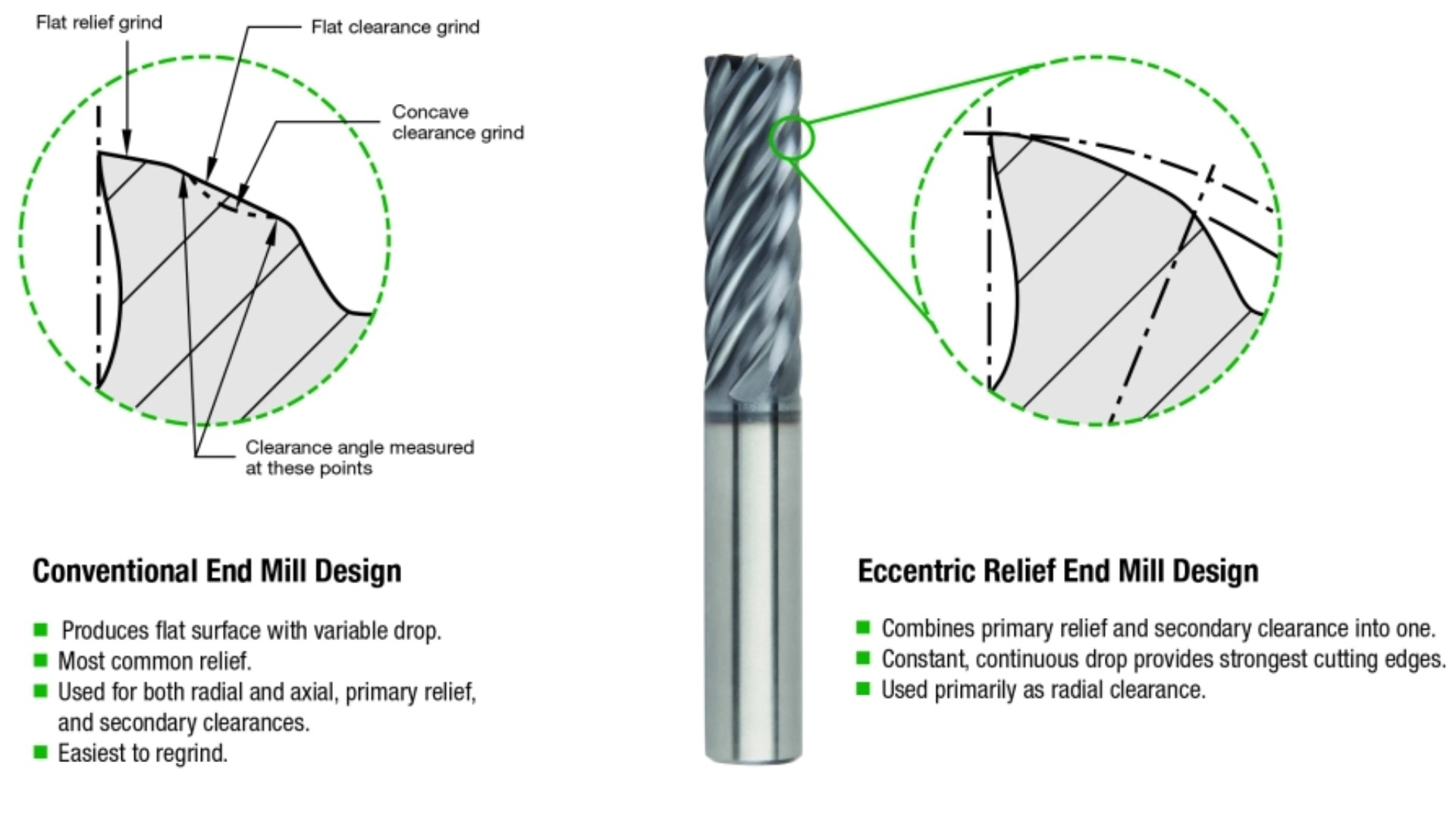
Concentric relief is ground using a wheel path that follows the same center as the tool. This creates a concave (hollow) profile immediately behind the cutting edge.
Pros:
- Easier and cheaper to manufacture
- Produces a very sharp initial cutting edge
- Good for light finishing in soft materials
Cons:
- Narrow supporting land behind the edge
- Weaker edge strength
- Faster edge breakdown and chipping
- Steeper wear curve — performance drops off quickly
Concentric relief is common in lower-cost, general-purpose end mills but often struggles in demanding applications.
Eccentric Relief: The Premium High-Performance Choice
Eccentric relief is ground from an offset (eccentric) center point, creating a convex profile behind the cutting edge. This leaves a wider, stronger land of solid carbide supporting the edge.
Key Advantages:
- Significantly stronger cutting edge
- Better resistance to chipping and micro-fracture
- More gradual, predictable wear
- Higher feed rate capability
- Longer overall tool life
- Maintains surface finish and dimensional accuracy longer
Eccentric relief requires advanced CNC grinding technology and tighter process control — which is why only premium manufacturers like CGS Tool make it standard across their lines.
Concentric vs Eccentric Relief – Side-by-Side Comparison
| Characteristic | Concentric Relief | Eccentric Relief |
|---|---|---|
| Relief Profile | Concave (hollow) | Convex (curved outward) |
| Edge Support Land | Narrow | Wide & robust |
| Cutting Edge Strength | Lower | Significantly higher |
| Wear Pattern | Rapid, steep drop-off | Gradual & predictable |
| Tool Life | Shorter in hard materials | Extended, especially in tough alloys |
| High-Feed Capability | Limited | Excellent |
| Best Applications | Light finishing, soft materials | Titanium, Inconel, hardened steels, roughing |
| Manufacturing Complexity | Simpler | Advanced CNC grinding required |
Why Eccentric Relief Matters in Real Shop Conditions
Modern CNC machining demands higher feeds, deeper cuts, and tougher materials. Eccentric relief excels here because it:
- Absorbs shock during interrupted cuts
- Reduces micro-chipping in titanium and Inconel
- Maintains consistent surface finishes longer
- Allows aggressive parameters without sudden tool failure
For production environments where every minute of downtime costs money, the predictability and durability of eccentric relief delivers a clear ROI through longer tool life and fewer tool changes.
CGS Tool’s Commitment to Eccentric Relief
At CGS Tool, eccentric OD relief is not optional — it is standard on nearly every premium series we manufacture. This design choice directly contributes to the superior performance our customers experience.
Featured Series with Eccentric Relief:
- VMAX MX Series – Best for Titanium & Inconel (nACRo coating + eccentric relief + variable helix)
- Ferocious Series – High-helix 2-flute for aluminum (ZrN + eccentric relief)
- Hi-Velocity HV Series – High-speed machining of steels & alloys
- HX Series – Heavy-duty roughing applications
Every CGS Tool end mill benefits from this reinforced edge geometry, paired with premium micro-grain carbide, advanced coatings, and variable pitch/helix designs.
Choosing the Right Relief for Your Application
- Choose Eccentric Relief if you machine: Titanium, Inconel, hardened steels (>40 HRC), stainless, or run high-feed strategies.
- Concentric Relief may suffice for: Very light finishing in aluminum or plastics on low-volume jobs.
For most professional shops, eccentric relief end mills pay for themselves quickly through extended tool life and higher productivity.
Final Thoughts
The difference between concentric and eccentric relief might seem small on paper, but it produces major results on the shop floor. Stronger edges, longer tool life, better finishes, and more aggressive cutting parameters are all direct benefits of eccentric relief geometry.
If you’re tired of premature tool wear, chipping, or inconsistent performance, it’s time to upgrade to tools engineered with proper edge support.
Ready to experience the difference? Explore CGS Tool’s full line of eccentric relief carbide end mills → www.cgstool.com
Have questions about which series is right for your material or application? Contact our technical team at sales@cgstool.com or call 330.273.5040.
What has been your experience with tool edge wear or chipping? Share in the comments below!